Trim saw buying guide
Best Trim Saws for Beginners: 4/5-inch vs 6-inch
Compare two compact wet trim saws by material clearance, table size, footprint and the kind of rough you actually expect to cut.
Beginner trim-saw picks
See the products before the deep dive
Start with the shortlist, then use the guide below to decide which tradeoffs actually matter for your batch.
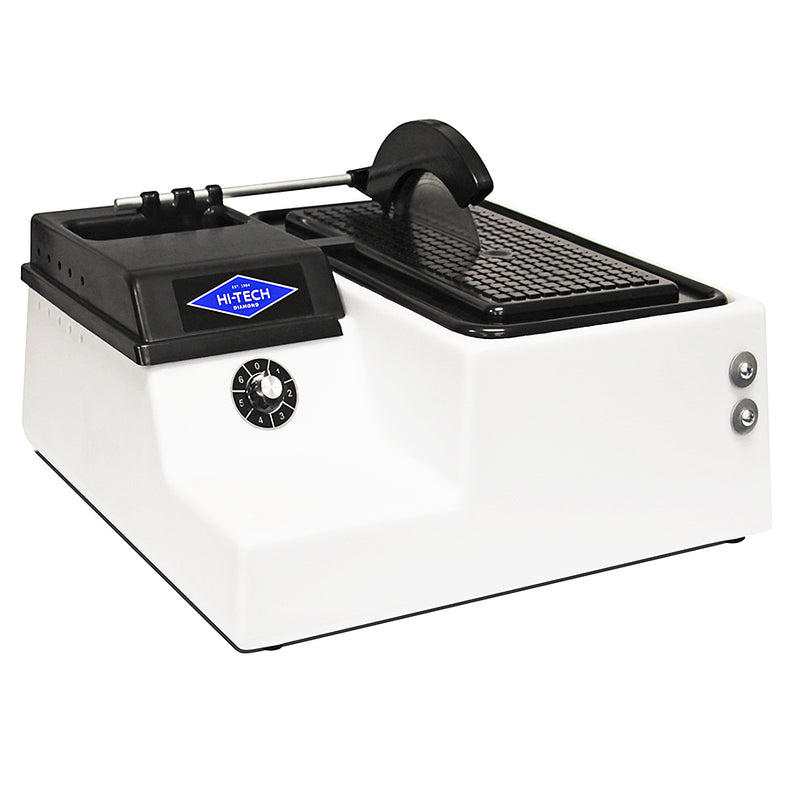
Hi-Tech Diamond 6-inch Trim Saw
Home lapidary users trimming cabochon preforms, facet rough and smaller slabs without stepping up to a full slab saw.
6 in blade; 1-3/4 in blade height Check Price on Amazon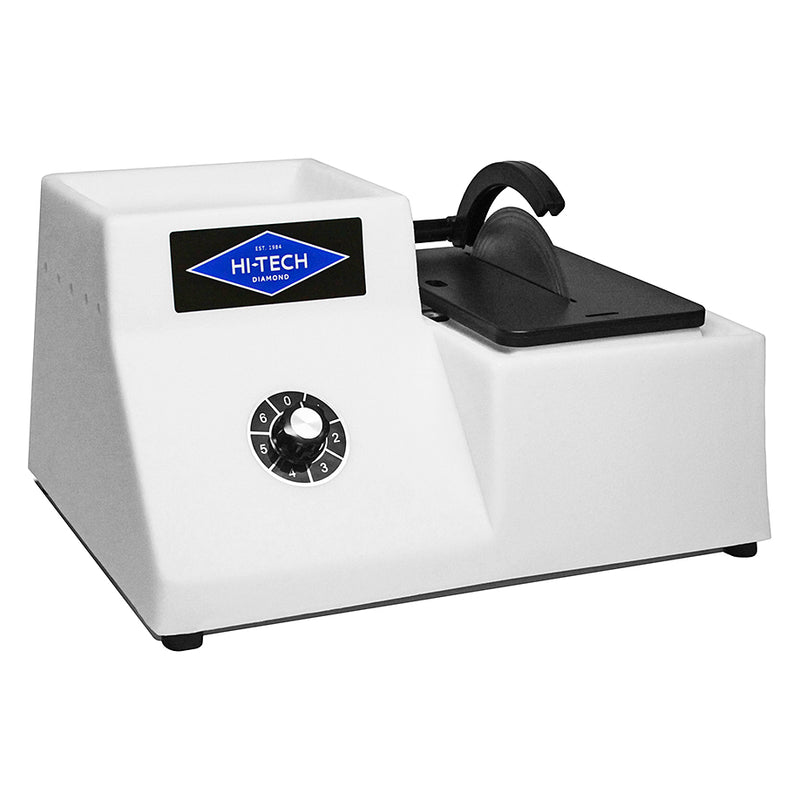
Hi-Tech Diamond 4/5-inch Trim Saw
Small cabochon preforms, faceting material and compact home benches where a 6-inch saw would be more machine than the normal work requires.
4/5 in blades; up to 1-1/2 in blade height with the 5 in blade Check Price on Amazon4/5-inch vs 6-inch trim saw at a glance
| Decision | 4/5-inch Trim Saw | 6-inch Trim Saw |
|---|---|---|
| Best role | Small preforms, faceting rough, limited space | General home-lapidary trimming |
| Blade options | Included 4 in and 5 in blades | Included 6 in notched and sintered blades |
| Blade height | 1 in with 4 in blade; 1-1/2 in with 5 in blade | 1-3/4 in |
| Work table | 7-1/2 x 4-3/4 in | 15-1/2 x 9 in |
| Machine size | 13 x 9-1/2 x 7 in; about 10 lb | 17 x 17 x 11 in; about 15 lb |
| Motor | 1/4 hp variable speed, 800–3,400 rpm | 1/4 hp variable speed, 800–3,400 rpm |
| Coolant reservoir | 8 oz | 16 oz |
Cutting height matters more than the blade number alone
A beginner usually notices the work table and material clearance before motor horsepower. Both Hi-Tech machines use the same stated 1/4 hp variable-speed range, but the 6-inch model gives you a much larger table and slightly more cutting height.
The 4/5-inch saw is the space-saving option
The smaller machine makes sense when your normal material is already close to cabochon size. It is roughly 10 lb and has a much smaller footprint, so it can fit a compact wet-work station without dedicating the whole bench to a saw. The tradeoff is simple: larger chunks reach its physical limits sooner.
Hi-Tech Diamond 4/5-inch Trim Saw
Best for: Small cabochon preforms, faceting material and compact home benches where a 6-inch saw would be more machine than the normal work requires.
Check Price on AmazonWhy it made the shortlist
- 1/4 hp variable-speed direct-drive motor rated from 800 to 3,400 rpm.
- Compact 13 x 9-1/2 x 7 in body weighs about 10 lb.
- Includes both 4 in and 5 in thin notched diamond blades, giving 1 in and 1-1/2 in blade-height options.
- Built-in 8 oz coolant reservoir and removable work table simplify a small wet-cutting station.
Know before buying
- The smaller table and 1-1/2 in maximum blade height are restrictive for chunkier rough.
- It is a trim saw for small work, not a substitute for a slab saw.
The 6-inch saw is the more versatile first purchase
The 6-inch model gives you a larger support table, twice the built-in coolant capacity and two blade styles intended for different materials. The extra room is useful when you are rotating a preform, cutting a wider slab or simply want more hand clearance around the work.
Hi-Tech Diamond 6-inch Trim Saw
Best for: Home lapidary users trimming cabochon preforms, facet rough and smaller slabs without stepping up to a full slab saw.
Check Price on AmazonWhy it made the shortlist
- 1/4 hp variable-speed direct-drive motor rated from 800 to 3,400 rpm.
- 15-1/2 x 9 in work table with a built-in 16 oz coolant reservoir.
- Accepts 6 in blades with a 5/8 in arbor.
- Manufacturer includes two different 6 in diamond blades, splash shield, apron, manual and one-year warranty.
Know before buying
- A trim saw is intended for smaller trimming work, not efficient slabbing of large rough.
- Wet cutting still creates splash and cleanup; plan a dedicated work surface.
- Blade choice, feed pressure and coolant practice matter as much as motor speed.
Do not buy a trim saw when the real job is slabbing rough
Cut a slab into a cabochon preform, remove waste from a smaller piece or make controlled short cuts in valuable material.
Turn a larger chunk, geode or rough block into parallel slabs or smaller pieces before detailed trimming begins.
If your material regularly approaches the limits of a 6-inch trim saw, compare the roles directly in Trim Saw vs Slab Saw instead of buying around the wrong job.
Beginner buying checklist
Material size
Measure the thickest rough you actually expect to cut, not the smallest finished cab.
Bench space
Leave splash and cleanup room around the machine rather than sizing the bench to the machine body alone.
Blade ecosystem
Check arbor size, replacement blades and which blade style fits the material you cut most often.
Wet-work routine
Plan coolant, drainage, drying and cleanup before the first cut so slurry does not spread across the shop.