Equipment review
CabKing 6 Review: Is a Six-Wheel Cabbing Machine Worth the Workshop Space?
Evaluate the six-wheel grit progression, water system, fixed-speed motor, bench footprint and long-term workflow before buying a dedicated cabbing station.
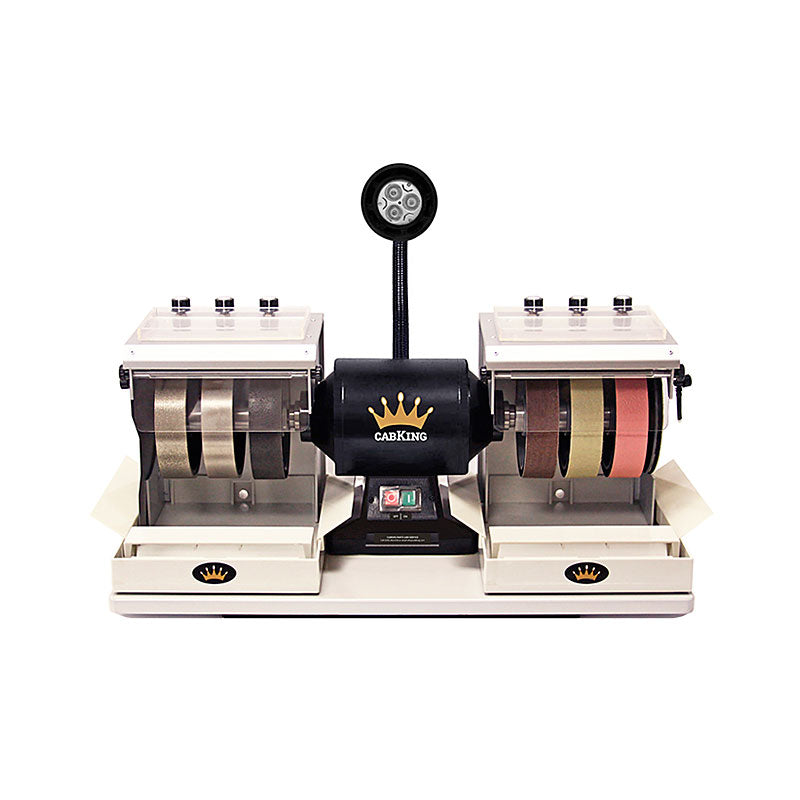
CabKing 6-inch Cabbing Machine
Best for: A serious home lapidary setup that wants one dedicated multi-wheel cabbing station from coarse grinding through pre-polish and polishing.
Check Price on AmazonWhy it made the shortlist
- Six-wheel rough-to-polish sequence: 80#, 220#, 280#, 600#, 1,200# and 3,000#.
- 1/4 hp direct-drive motor with a fixed 1,800 rpm operating speed.
- Separate water pump, adjustable water system, trays, hand rests and splash guards are included.
- Machine measures about 27 x 13.5 x 12 in and weighs 62 lb.
Know before buying
- High purchase price and 62 lb weight make this a dedicated-workbench machine rather than a casual portable tool.
- Replacement wheels, polishing consumables and water-management setup add ongoing cost.
- A dedicated trim saw or optional attachment may still be useful for preparing rough before cabbing.
→
→
→
→
→
Why a six-wheel cabbing machine feels different from a flat lap
Instead of changing discs on one horizontal platen, the CabKing keeps a progression of wheels ready at the same time. That speeds up repeated cabochon work and makes scratch progression easier to organize, but it costs more space, money and maintenance than a compact flat lap.
CabKing 6 workshop facts
| Wheel sequence | 80, 220, 280, 600, 1,200 and 3,000 grit | Dedicated rough-to-fine workflow without swapping the primary wheels each stage. |
|---|---|---|
| Side stations | 360# full-face lap + canvas pad with 14,000# diamond paste | Adds flat work and final polishing capability to the wheel progression. |
| Motor | 1/4 hp direct drive, fixed 1,800 rpm | Simple dedicated operating speed; not a variable-speed platform. |
| Power | 110V model: 3.2 A / 352 W | Plan an outlet and cord route away from the wet work area. |
| Water | Separate 30 W pump and adjustable water delivery | Requires a deliberate wet-work setup and drainage plan. |
| Size / weight | 27 x 13.5 x 12 in; 62 lb | Plan a permanent stable bench rather than moving it after every session. |
What is included
Two electroplated grinding wheels (80# and 220#) plus four resin wheels (280#, 600#, 1,200# and 3,000#).
A 360# full-face diamond lap and canvas polishing pad with 14,000# diamond paste.
Separate 30 W pump, adjustable delivery, removable stone trays, hand rests and splash guards.
Waterproof apron, safety goggles, instruction manual and a one-year manufacturer warranty.
Plan a permanent 2 x 3 ft work zone
The manufacturer recommends roughly a 2 x 3 ft cleared area for the 6-inch machine. At 62 lb, this is not something most users will want to lift away after every session. Give the machine a rigid, well-lit bench, room for the water reservoir/pump arrangement and enough side clearance to work comfortably at the end stations.
Keep the wet zone contained and leave room for hands, water lines and removable trays.
Water is part of the cutting system
The separate pump feeds adjustable water to the wheels. Water cools the stone and wheel surface and carries away grinding debris. The useful habit is not simply “more water”: direct enough clean water to the active contact zone, keep drains clear and clean trays before slurry becomes a hardened maintenance problem.
How to use the wheel progression
Establish and refine the cabochon shape while removing saw marks and major defects.
Replace the grinding scratches with progressively finer ones; inspect under good light between wheels.
Prepare a clean, uniform surface for the final polishing step.
Polish only after the earlier scratch pattern is fully removed.
Budget beyond the machine
Replacement grinding and resin wheels are a meaningful long-term cost.
Pump, tubing, valves and trays become part of normal upkeep.
Routine cleaning makes it easier to spot wear and prevents dried slurry buildup.
A trim-saw attachment can expand the platform, but it adds cost and does not turn the machine into a large slab saw.
Who gets the most value from it?
You make cabochons regularly, value a fixed wheel progression and have a permanent wet-work bench.
You are still experimenting with occasional flats or only polish a few pieces at a time. A flat lap is easier to justify.