Workshop decision guide
Cabbing Machine vs Flat Lap vs Trim Saw: What Should You Buy First?
Choose your first lapidary machine by the operation blocking your workflow, then compare space, water, consumables and the machines you may still need later.
Compare three workshop paths
See the products before the deep dive
Start with the shortlist, then use the guide below to decide which tradeoffs actually matter for your batch.
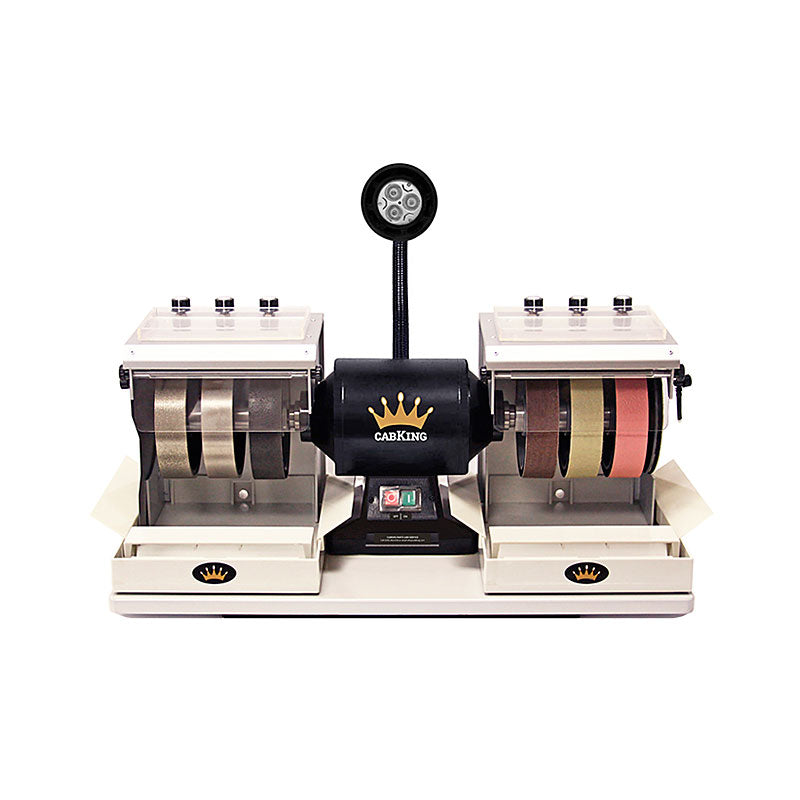
CabKing 6-inch Cabbing Machine
A serious home lapidary setup that wants one dedicated multi-wheel cabbing station from coarse grinding through pre-polish and polishing.
Six 6 in diamond wheels + side laps Check Price on Amazon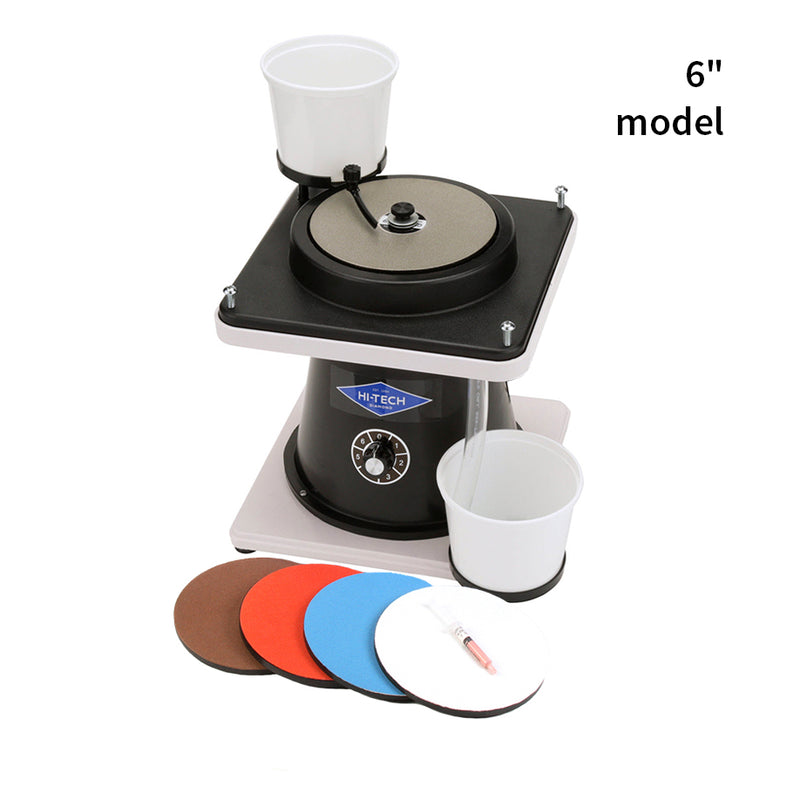
Hi-Tech Diamond All-U-Need 6-inch Rock/Mineral
Beginners who want a compact flat-lap machine for shaping, smoothing and polishing cabochons and flat rock surfaces.
6 in lap; 2-1/4 in working radius Check Price on Amazon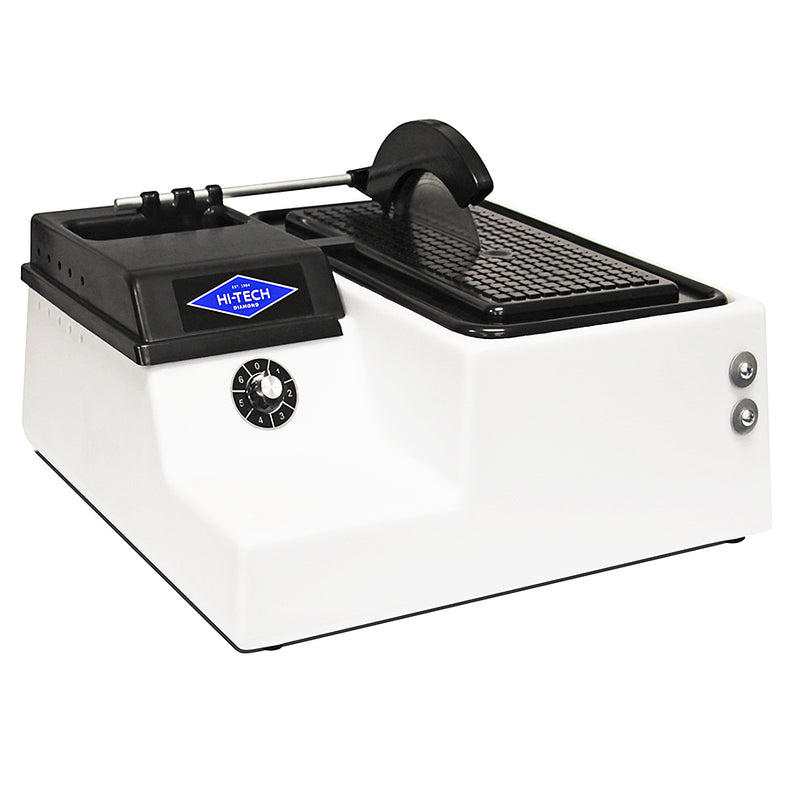
Hi-Tech Diamond 6-inch Trim Saw
Home lapidary users trimming cabochon preforms, facet rough and smaller slabs without stepping up to a full slab saw.
6 in blade; 1-3/4 in blade height Check Price on AmazonTurn slabs and small rough into controlled blanks.
Best first when cutting is the bottleneck.
Grind and polish flats, backs, freeforms and occasional cabs with changeable discs.
Best first when flexibility and space matter.
Shape and polish cabochons through a fixed wheel progression.
Best first when cabbing volume is already high.
Three machines, three different bottlenecks
| Machine | Main operation | What it does not replace | Home-shop burden |
|---|---|---|---|
| Trim saw | Controlled small cutting | Grinding/polishing station or large slab saw | Wet cutting, blade replacement, splash cleanup |
| Flat lap | Flat grinding and polishing | Rough cutting; dedicated multi-wheel throughput | Disc changes, water, consumables |
| Cabbing machine | Repeated curved shaping/polishing | Large rough slabbing; sometimes trim cutting | Permanent bench, many wheels, pump/water system |
Path 1: buy a trim saw first
This is the most logical path when you already own or buy slabs and need to remove waste before shaping. A trim saw can also prepare cabochon preforms for a flat lap or cabbing machine. It does not turn a large nodule into slabs efficiently; that is a slab-saw job.
Hi-Tech Diamond 6-inch Trim Saw
Best for: Home lapidary users trimming cabochon preforms, facet rough and smaller slabs without stepping up to a full slab saw.
Check Price on AmazonWhy it made the shortlist
- 1/4 hp variable-speed direct-drive motor rated from 800 to 3,400 rpm.
- 15-1/2 x 9 in work table with a built-in 16 oz coolant reservoir.
- Accepts 6 in blades with a 5/8 in arbor.
- Manufacturer includes two different 6 in diamond blades, splash shield, apron, manual and one-year warranty.
Know before buying
- A trim saw is intended for smaller trimming work, not efficient slabbing of large rough.
- Wet cutting still creates splash and cleanup; plan a dedicated work surface.
- Blade choice, feed pressure and coolant practice matter as much as motor speed.
Path 2: buy a flat lap first
A flat lap offers the broadest compact finishing workflow because one horizontal platen can accept multiple grinding and polishing discs. It works especially well for flats, backs and freeforms, and it can produce cabochons with practice. The tradeoff is stopping to change abrasive surfaces instead of moving across fixed wheels.
Hi-Tech Diamond All-U-Need 6-inch Rock/Mineral
Best for: Beginners who want a compact flat-lap machine for shaping, smoothing and polishing cabochons and flat rock surfaces.
Check Price on AmazonWhy it made the shortlist
- 1/4 hp variable-speed direct-drive motor rated from 800 to 3,400 rpm.
- Compact 10 x 10 x 12 in machine footprint and 9 lb machine weight.
- Rock/mineral kit includes 180# lap, 325/600/1200 smoothing discs, polishing pad and 14,000# diamond paste.
- Built-in water setup supports wet grinding and polishing.
Know before buying
- Six-inch working area is more compact than the 8-inch model for larger flats and broad pieces.
- Consumable discs and backing plates become part of the long-term operating cost.
- It is a flat-lap workflow, not a substitute for a saw when material must be cut first.
Path 3: buy a cabbing machine first
A dedicated six-wheel machine is the throughput choice. Each abrasive stage stays mounted, water is directed to the active wheel and you move the stone from left to right through the sequence. It is faster for repeated cabochon work but costs more, occupies more bench space and does not eliminate the need to cut rough.
CabKing 6-inch Cabbing Machine
Best for: A serious home lapidary setup that wants one dedicated multi-wheel cabbing station from coarse grinding through pre-polish and polishing.
Check Price on AmazonWhy it made the shortlist
- Six-wheel rough-to-polish sequence: 80#, 220#, 280#, 600#, 1,200# and 3,000#.
- 1/4 hp direct-drive motor with a fixed 1,800 rpm operating speed.
- Separate water pump, adjustable water system, trays, hand rests and splash guards are included.
- Machine measures about 27 x 13.5 x 12 in and weighs 62 lb.
Know before buying
- High purchase price and 62 lb weight make this a dedicated-workbench machine rather than a casual portable tool.
- Replacement wheels, polishing consumables and water-management setup add ongoing cost.
- A dedicated trim saw or optional attachment may still be useful for preparing rough before cabbing.
Where the CabKing 8 fits
The CabKing 8 is not a different branch in the decision tree. It is a larger version of the cabbing-machine branch. Choose it when the 6-inch machine’s wheel width and spacing become the constraint, not simply because the 8-inch model is more expensive.
Trim saw
Cut a controlled blank.
→
Flat lap or cabbing machine
Establish geometry and remove saw marks.
→
Fine abrasive + polish
Refine scratches, then develop luster.
Do you need two machines?
A trim saw plus 6-inch flat lap is a flexible two-machine path that covers cutting and finishing without a full cabbing station.
A trim saw plus six-wheel cabbing machine reduces abrasive-change time and creates a more production-oriented workflow.
Decision checklist
Look at a slab saw before any of these three.
Trim saw first.
Flat lap first.
Cabbing machine first.