Cabbing machine buying guide
Best Cabbing Machines for a Home Workshop: CabKing 6 vs 8
Compare CabKing 6 and CabKing 8 by wheel size, motor, bench footprint, water system, replacement cost and the size of material you actually shape.
Home-workshop cabbing picks
See the products before the deep dive
Start with the shortlist, then use the guide below to decide which tradeoffs actually matter for your batch.
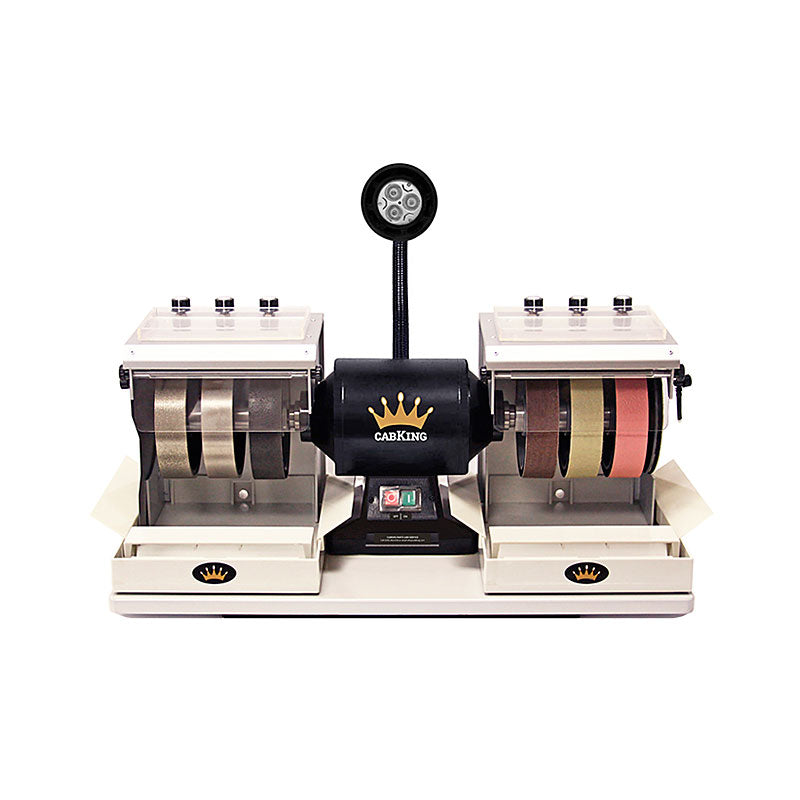
CabKing 6-inch Cabbing Machine
A serious home lapidary setup that wants one dedicated multi-wheel cabbing station from coarse grinding through pre-polish and polishing.
Six 6 in diamond wheels + side laps Check Price on Amazon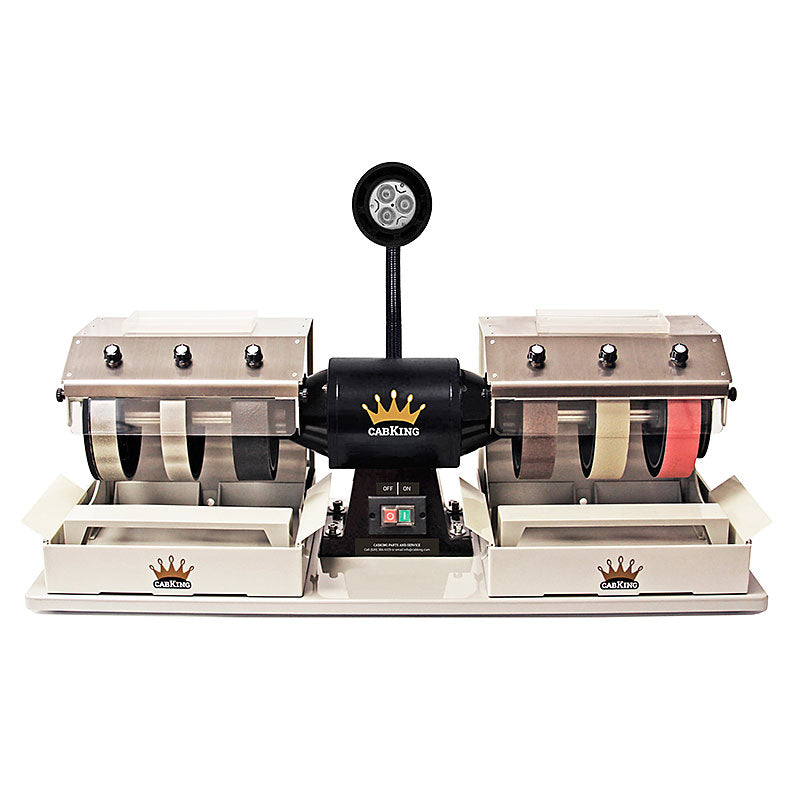
CabKing 8-inch Cabbing Machine
Serious home workshops, studios and clubs that need wider 8-inch wheels, more spacing and room for larger cabochons.
Six 8 in wheels; 42 x 16 x 14 in; 160 lb Check Price on AmazonCabKing 6 vs CabKing 8 at a glance
| Decision | CabKing 6 | CabKing 8 |
|---|---|---|
| Primary fit | Serious home hobbyist | High-volume home shop, studio or club |
| Main wheels | Six 6-inch wheels | Six 8-inch wheels |
| Motor | 1/4 hp direct drive | 3/4 hp direct drive |
| Speed | Fixed 1,800 rpm | Fixed 1,800 rpm |
| Machine size | 27 x 13.5 x 12 in | 42 x 16 x 14 in |
| Weight | 62 lb | 160 lb |
| Cleared work zone | About 2 x 3 ft | About 2 x 4 ft |
| Why step up | Complete wheel workflow in a manageable footprint | Wider wheels and more spacing for larger material |
CabKing 6 is the home-workshop default
The 6-inch platform already gives you a dedicated sequence from coarse shaping through pre-polish, plus side stations for a flat lap and final polish. For a home user, the strongest argument is not that 6-inch wheels are “beginner” wheels. It is that the machine is easier to place, easier to move during setup and less expensive to re-wheel over time.
CabKing 6-inch Cabbing Machine
Best for: A serious home lapidary setup that wants one dedicated multi-wheel cabbing station from coarse grinding through pre-polish and polishing.
Check Price on AmazonWhy it made the shortlist
- Six-wheel rough-to-polish sequence: 80#, 220#, 280#, 600#, 1,200# and 3,000#.
- 1/4 hp direct-drive motor with a fixed 1,800 rpm operating speed.
- Separate water pump, adjustable water system, trays, hand rests and splash guards are included.
- Machine measures about 27 x 13.5 x 12 in and weighs 62 lb.
Know before buying
- High purchase price and 62 lb weight make this a dedicated-workbench machine rather than a casual portable tool.
- Replacement wheels, polishing consumables and water-management setup add ongoing cost.
- A dedicated trim saw or optional attachment may still be useful for preparing rough before cabbing.
CabKing 8 buys working room, not a different process
The 8-inch machine keeps the same basic six-wheel concept but uses wider 8-inch wheels, more spacing and a much stronger 3/4 hp motor. That matters when larger stones and repeated production work make the 6-inch work area feel cramped. It does not make the sanding sequence shorter; it makes the physical workspace more generous.
CabKing 8-inch Cabbing Machine
Best for: Serious home workshops, studios and clubs that need wider 8-inch wheels, more spacing and room for larger cabochons.
Check Price on AmazonWhy it made the shortlist
- Six-wheel rough-to-polish sequence uses 80#, 220#, 280#, 600#, 1,200# and 3,000# wheels.
- 3/4 hp direct-drive motor runs at a fixed 1,800 rpm.
- Wider 8 in wheels and generous spacing make larger stones easier to manage than on the 6 in machine.
- Separate 30 W water pump, adjustable water delivery, hand rests, splash guards and trays are included.
Know before buying
- At about 160 lb, the machine needs a permanent, very sturdy bench and two-person setup.
- The 42 in body needs a much larger cleared work zone than a 6 in cabbing machine or flat lap.
- Replacement 8 in wheels and the higher purchase price make it difficult to justify for occasional cabbing.
Wheel progression is the reason to buy a cabbing machine
Remove saw marks and establish the cab profile.
Take out deep shaping scratches.
Replace coarse scratches with a controlled finer pattern.
Build a uniformly refined surface before polish.
Bench and water planning come before the purchase
Plan a rigid bench with roughly a 2 x 3 ft cleared work area, plus room for the pump, reservoir and drying supplies.
Plan roughly a 2 x 4 ft cleared zone and a bench that can safely support a 160 lb wet machine without flexing.
Both machines are fixed-speed wet stations. Put outlets and extension connections away from the splash zone, use GFCI protection where required, and follow the electrical and water setup in the manufacturer manual.
What costs continue after the machine?
Wheels are consumables. Larger 8-inch replacements usually cost more than 6-inch equivalents.
Paste, pads and specialty laps remain recurring shop items.
Pumps, tubing, valves and trays need cleaning and occasional replacement.
A cabbing machine does not replace a slab saw. A trim-saw attachment or separate saw may still be needed.
Who should choose each machine?
Your normal work is jewelry-scale cabochons, you want a complete fixed-wheel workflow and workshop space matters.
You regularly shape larger stones, want wider wheel faces and already have a permanent heavy-duty bench.
You polish occasional pieces, work many flats or cannot justify six dedicated wheels yet.
Your main bottleneck is getting rough or slabs into workable preforms rather than shaping and polishing them.