Slab saw buying guide
Best Slab Saws for Beginners: Start With the Right Capacity
Choose a slab-saw class from the size of your rough, then compare blade system, coolant, bench space and ongoing consumable cost before buying.
Beginner slab-saw setup
See the products before the deep dive
Start with the shortlist, then use the guide below to decide which tradeoffs actually matter for your batch.
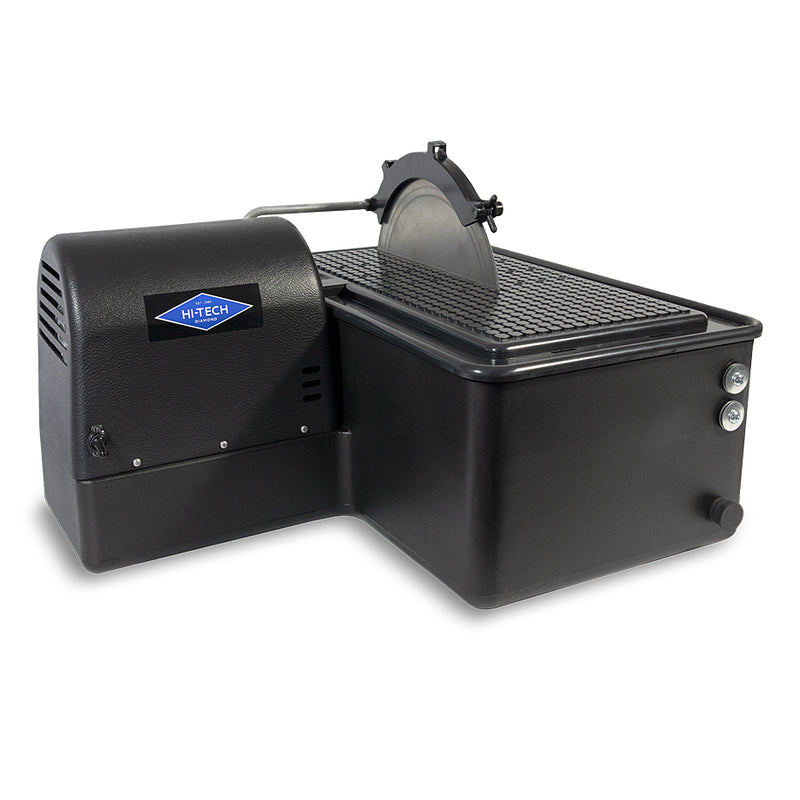
Hi-Tech Diamond 10-inch Slab Saw
Home workshops that need to turn larger rough, geodes and chunks into manageable slabs before trimming and cabbing.
10 in blade; 9-3/4 in blade depth Check Price on Amazon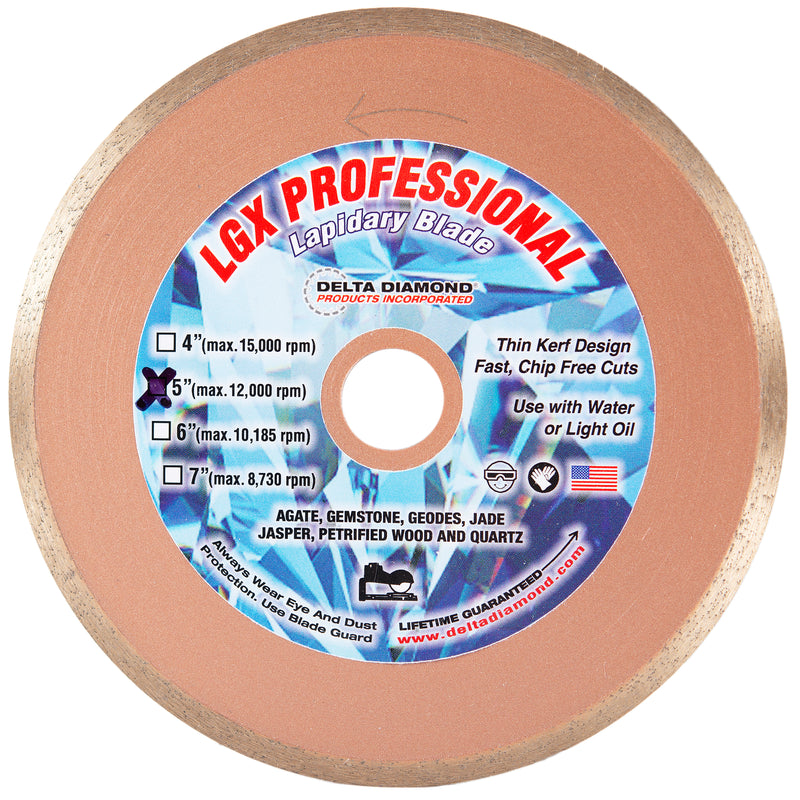
Delta Diamond Products LGX Professional 10-inch Lapidary Blade
10-inch lapidary saws that accept a 5/8-inch arbor and need a thin professional blade for agate, jasper, quartz, geodes and similar stone.
10 in diameter x .040 in kerf x 5/8 in arbor Check Price on AmazonStart by separating trimming from slabbing
Use it when the material is already a slab or small piece and you need accurate preforms, edge cleanup or short controlled cuts.
Use it when a chunk or nodule needs to become parallel slabs or manageable pieces before detailed trimming begins.
If you are still unsure which operation you need, read Trim Saw vs Slab Saw first. Buying a larger blade does not convert a trim-saw workflow into a slab-saw workflow.
Why 10 inches is a useful beginner slab-saw size
A 10-inch saw gives noticeably more blade exposure than a 6-inch trim saw while remaining small enough for a serious home bench. It is still a wet machine with slurry, splash control, blade maintenance and a reservoir to manage, so “compact” does not mean countertop-clean.
Hi-Tech Diamond 10-inch Slab Saw
Best for: Home workshops that need to turn larger rough, geodes and chunks into manageable slabs before trimming and cabbing.
Check Price on AmazonWhy it made the shortlist
- 1/3 hp motor runs at 1,725 rpm.
- 19-3/4 x 12 in removable saw table and built-in 2.5 qt coolant reservoir.
- Machine measures 19 x 21 x 12 in and weighs about 35 lb.
- Includes two 10 in diamond blades, spray shield, apron, manual and one-year warranty.
Know before buying
- A 35 lb wet saw needs a stable dedicated work surface and more cleanup room than a trim saw.
- It is built for larger cuts, so it is not the most efficient choice for tiny cabochon trimming.
- Blade, coolant and feed technique remain ongoing operating considerations.
What changes when you move beyond 10 inches?
| Category | What you gain | What gets harder |
|---|---|---|
| 10-inch | Manageable home-workshop footprint and useful capacity for moderate rough | Still limited when rough is consistently large or very deep |
| 12–14 inch | More blade exposure and room for larger nodules | Heavier chassis, larger coolant volume, higher blade cost |
| 16–18+ inch | Production-style slabbing of larger material | Permanent shop space, significant weight, oil/coolant management and expensive consumables |
The blade is part of the saw purchase
Blade diameter is only the first compatibility check. Arbor size, kerf, flange clearance, guard clearance and the saw’s intended shaft speed all matter. A thin premium blade can reduce material loss, but a mismatched blade can be unsafe or perform poorly.
Delta Diamond Products LGX Professional 10-inch Lapidary Blade
Best for: 10-inch lapidary saws that accept a 5/8-inch arbor and need a thin professional blade for agate, jasper, quartz, geodes and similar stone.
Check Price on AmazonWhy it made the shortlist
- 10 x .040 x 5/8 in configuration is listed in the current LGX size range.
- Thin-rim design is intended to reduce waste and leave smoother cuts on valuable material.
- Manufacturer lists water for glass and softer porous material and cutting oil for dense harder material.
- Made for gemstone, quartz, agate, geodes, petrified wood, jasper and related lapidary cutting.
Know before buying
- Coolant choice must also match the saw manufacturer's instructions; never change fluid only because a blade page mentions another option.
- Confirm blade guard, flange, arbor and maximum blade diameter before installation.
- A 10-inch blade belongs in a compatible saw; it is not an upgrade for a smaller trim-saw chassis.
Plan the whole wet-cutting station
Support the saw weight plus fluid and rough without rocking or flexing.
Use only the fluid type permitted by both saw and blade documentation.
Protect nearby surfaces and keep electrical connections out of the wet area.
Remove slurry before it hardens and inspect the blade before storage.
Do not size the saw around one unusually large rock
Buy for the material you expect to process repeatedly. If nearly every piece is smaller than trim-saw capacity, a slab saw may spend most of its life doing a job a smaller saw could do with less cleanup. If most of your rough is too large for a 10-inch machine, jumping straight to a larger slab-saw class can make more sense than buying twice.
Beginner slab-saw checklist
Measure rough
Record the thickness and width of the material you actually collect or buy.
Confirm blade system
Check diameter, arbor, kerf, flange and recommended speed before ordering replacements.
Choose coolant deliberately
Follow the saw manual first; then make sure the selected blade is compatible with that fluid.
Budget for blades
Large premium blades are recurring consumables, not a one-time accessory.