Lapidary consumables guide
How to Choose a Lapidary Diamond Blade
Match diameter, arbor, kerf, rim style, speed and coolant to your saw before comparing premium 6-inch and 10-inch blade options.
Blade examples by saw size
See the products before the deep dive
Start with the shortlist, then use the guide below to decide which tradeoffs actually matter for your batch.
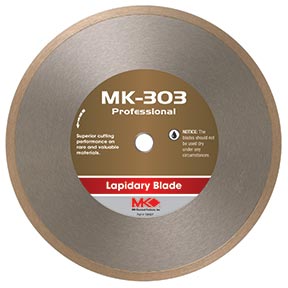
MK Diamond MK-303 Professional 6-inch Blade (153690)
A 6-inch lapidary saw that accepts a 5/8-inch arbor and needs a professional continuous-rim blade for precise cuts with low material loss.
6 in diameter x .032 in kerf x 5/8 in arbor; part 153690 Check Price on Amazon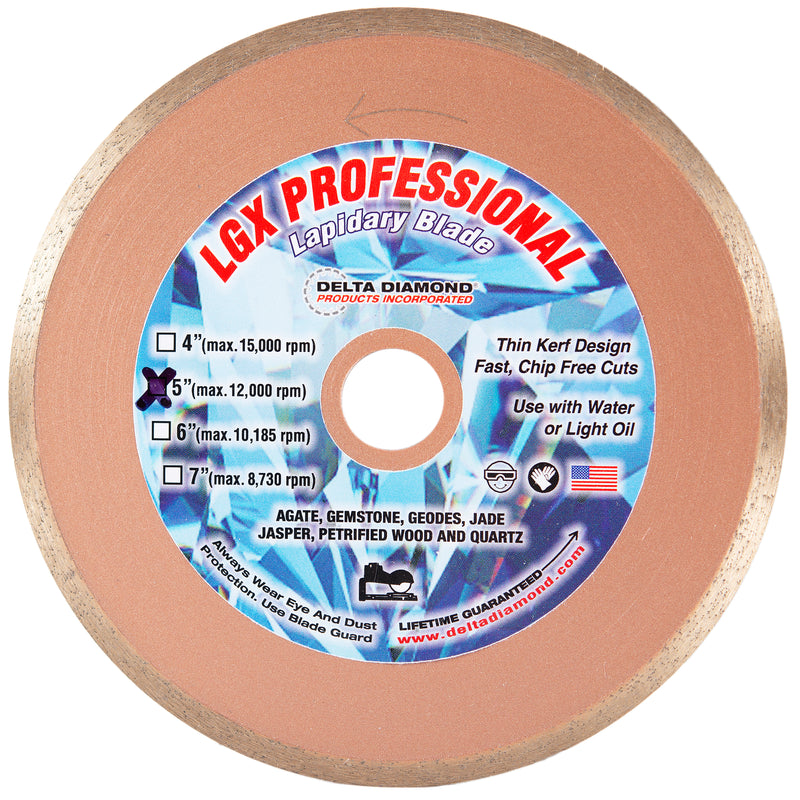
Delta Diamond Products LGX Professional 10-inch Lapidary Blade
10-inch lapidary saws that accept a 5/8-inch arbor and need a thin professional blade for agate, jasper, quartz, geodes and similar stone.
10 in diameter x .040 in kerf x 5/8 in arbor Check Price on AmazonFour measurements decide whether a blade can fit
Must be within the saw’s rated blade size and guard clearance.
The center hole must match the saw arbor or an approved bushing arrangement.
Blade width changes material loss, stiffness and sometimes flange clearance.
The saw’s shaft speed must stay inside the blade manufacturer’s permitted range.
6-inch precision example: MK-303 Professional
MK Diamond describes the MK-303 as a professional blade for valuable lapidary material where low waste and a smooth cut matter. Part 153690 is the 6-inch, .032-inch-wide, 5/8-inch-arbor version. MK specifies water-soluble coolant for the MK-303 family.
MK Diamond MK-303 Professional 6-inch Blade (153690)
Best for: A 6-inch lapidary saw that accepts a 5/8-inch arbor and needs a professional continuous-rim blade for precise cuts with low material loss.
Check Price on AmazonWhy it made the shortlist
- MK-303 is designed for valuable lapidary material where smooth cutting and low waste matter.
- Part 153690 is the 6 x .032 x 5/8 in version in MK Diamond's current size table.
- Manufacturer specifies water-soluble coolant for this blade family.
- Continuous-rim construction is intended for smooth, precise lapidary cuts.
Know before buying
- Match blade diameter, arbor, kerf clearance and machine speed before buying; the part number alone does not guarantee compatibility.
- A thin premium blade still needs correct coolant flow and gentle feed pressure.
- Dry and protect the blade for storage according to the saw/blade manufacturer's instructions.
10-inch precision example: Delta LGX
The Delta LGX line includes a 10 x .040 x 5/8-inch configuration. Delta positions the line for smooth low-waste cutting of gemstones, agate, quartz, geodes, petrified wood and jasper. Its guidance distinguishes water use for glass/softer porous materials from light cutting oil for dense harder material—provided your saw also permits that fluid.
Delta Diamond Products LGX Professional 10-inch Lapidary Blade
Best for: 10-inch lapidary saws that accept a 5/8-inch arbor and need a thin professional blade for agate, jasper, quartz, geodes and similar stone.
Check Price on AmazonWhy it made the shortlist
- 10 x .040 x 5/8 in configuration is listed in the current LGX size range.
- Thin-rim design is intended to reduce waste and leave smoother cuts on valuable material.
- Manufacturer lists water for glass and softer porous material and cutting oil for dense harder material.
- Made for gemstone, quartz, agate, geodes, petrified wood, jasper and related lapidary cutting.
Know before buying
- Coolant choice must also match the saw manufacturer's instructions; never change fluid only because a blade page mentions another option.
- Confirm blade guard, flange, arbor and maximum blade diameter before installation.
- A 10-inch blade belongs in a compatible saw; it is not an upgrade for a smaller trim-saw chassis.
Continuous rim vs notched rim
Common choice when smooth cuts and low kerf loss are priorities. It relies on correct coolant and gentle, consistent feed.
Can improve coolant access or durability in certain materials and larger diameters. Use the style specified for the saw and material—not a generic masonry blade.
Thin kerf saves stone but reduces your margin for abuse
Less material loss and a narrower cut; rewards a stable saw and controlled feed.
More material removed, often with more stiffness; may suit heavier cutting depending on the blade design.
Do not force a blade because it cuts slowly. A glazed rim, wrong coolant, incorrect speed, unstable material or too much feed pressure can all look like a “dull blade” problem.
Blade speed is a compatibility check, not a tuning contest
Blade manufacturers publish operating ranges because rim speed changes with diameter. The same shaft rpm produces a much higher rim speed on a large blade than on a small one. Never increase speed beyond the saw or blade rating in an attempt to make a cut faster.
Coolant choice comes from both manuals
Storage and inspection
Remove slurry and residue before it dries on the rim and flanges.
Dry steel-core blades thoroughly after wet use.
Use the corrosion protection recommended by the blade manufacturer for storage.
Do not run a warped, cracked, damaged or improperly mounted blade.