Equipment review
Hi-Tech Diamond 10-inch Slab Saw Review: When a Home Workshop Needs More Cutting Capacity
See what the larger blade, 35 lb footprint, 1/3 hp motor and wet-cutting reservoir change compared with a compact trim saw.
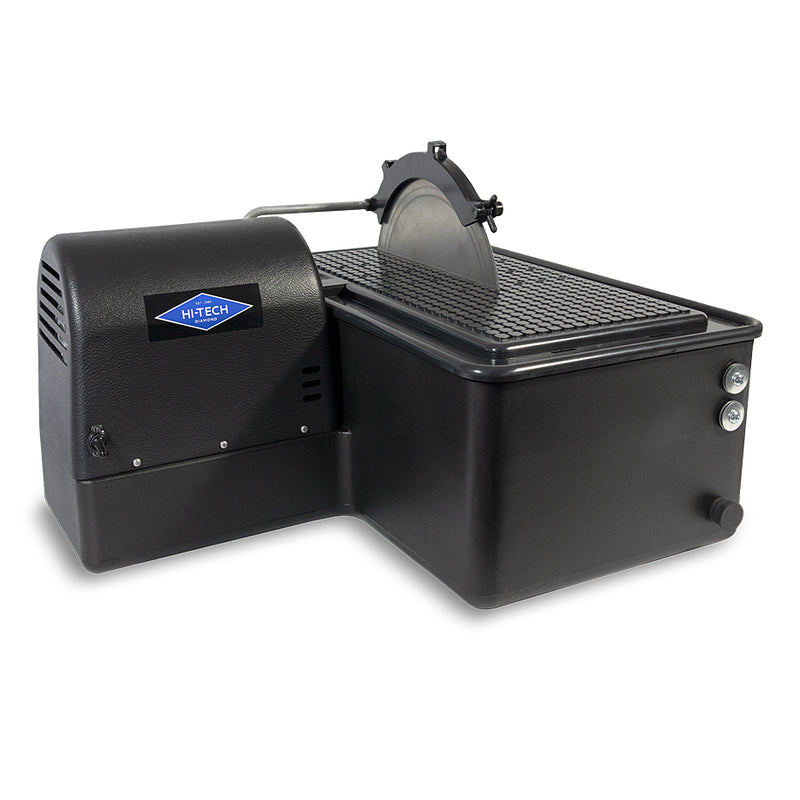
Hi-Tech Diamond 10-inch Slab Saw
Best for: Home workshops that need to turn larger rough, geodes and chunks into manageable slabs before trimming and cabbing.
Check Price on AmazonWhy it made the shortlist
- 1/3 hp motor runs at 1,725 rpm.
- 19-3/4 x 12 in removable saw table and built-in 2.5 qt coolant reservoir.
- Machine measures 19 x 21 x 12 in and weighs about 35 lb.
- Includes two 10 in diamond blades, spray shield, apron, manual and one-year warranty.
Know before buying
- A 35 lb wet saw needs a stable dedicated work surface and more cleanup room than a trim saw.
- It is built for larger cuts, so it is not the most efficient choice for tiny cabochon trimming.
- Blade, coolant and feed technique remain ongoing operating considerations.
Preforms and detail trimming.
vs
Parallel slabs and manageable chunks.
What changes when you move to a 10-inch saw?
| Motor | 1/3 hp at 1,725 rpm | Built around larger cuts rather than fine trimming speed adjustment. |
|---|---|---|
| Table | 19-3/4 x 12 in | More room to support larger material. |
| Blade / arbor | 10 in blade on 5/8 in arbor | Designed for a larger cutting envelope than the 6-inch trim saw. |
| Blade height / depth | 3-3/4 in / 9-3/4 in | Useful when rough is too large for a small trim platform. |
| Coolant | 2.5 qt built-in reservoir | More wet-cutting capacity, but more slurry to manage. |
| Machine | 19 x 21 x 12 in; 35 lb | Needs a stable bench and intentional cleanup zone. |
What comes with the saw
10 x .031 x .044 in for many rocks and minerals.
10 x .031 x .038 in for materials including glass, quartz and fine agate.
Helps contain a wetter, messier cutting process than small trim work.
Allen wrench, instructions and one-year manufacturer warranty are included.
Set up the cutting station around weight and runoff
At about 35 lb before coolant and material, this is better treated as a dedicated station.
The included blade pair covers different material types; do not treat them as interchangeable simply because both fit.
The 2.5 qt reservoir supports wet cutting; make sure the blade carries coolant through the cut zone.
Use a controlled feed and optional vise when it improves consistency and hand position.
A slab saw is the first step, not the whole workflow
→
→
→
After cutting, saw marks need to be removed and the shape still needs grinding, smoothing and polishing. Pair the saw decision with a realistic plan for a flat lap or cabbing machine rather than treating slabbing as an isolated purchase.
Maintenance and consumables
The built-in drain simplifies cleanup, but slurry should not be allowed to harden in the reservoir.
Blade wear becomes a recurring cost and affects cut quality.
Slurry on shields and the work table can hide cracks, loosened hardware and contamination.
Optional work-holding can improve repeatability when your rough and cut style benefit from it.
Who should buy it?
Your material regularly arrives as rough that needs real slabbing before trimming and cabbing.
Most of your material already arrives as slabs or small pieces; a trim saw can be a more efficient use of space and budget.